Home / The jQuery Immortality Report (2026)
Data
The jQuery Immortality Report (2026)
By SearchWebCode · Source snapshot 2026-08 · Editorial update October 14, 2026
jquery.min.js query has a reported estimate of 31,500,000 homepage matches in a 129,313,463-domain index. The 68% figure covers summed 1.x–3.x version estimates only, with overlapping populations. 4.x was not measured. These source footprints do not prove runtime execution or security exposure.This is an archived footprint study of 129,313,463 unique-domain homepages from the August 2026 source index, with sampling reported on September 4. Its tables preserve reported sample estimates and candidate bounds. It does not measure runtime execution or a complete population of jQuery installations.
Canonical filename matches in the August snapshot
The canonical minified filename jquery.min.js appears in the homepage source of about 31,500,000 domains, 24.4% of the index. The reported estimate for this footprint is larger than each selected framework footprint in the table below. This is a rounded sample estimate for one filename. Other filenames and bundled or injected code are outside that query. Sampling uncertainty means the estimate is not a proven lower bound on all jQuery installations.
| How jQuery is shipped | Footprint | Homepages | Share of index |
|---|---|---|---|
| Minified core (canonical) | jquery.min.js | 31,500,000 | 24.36% |
| Unminified core | jquery.js | 7,830,000 | 6.06% |
| Slim build | jquery.slim.min.js | 71,500 | 0.06% |
The rows overlap and are not additive: a page loading jquery-3.6.0.min.js from a CDN matches none of them. Re-run: minified · unminified · slim
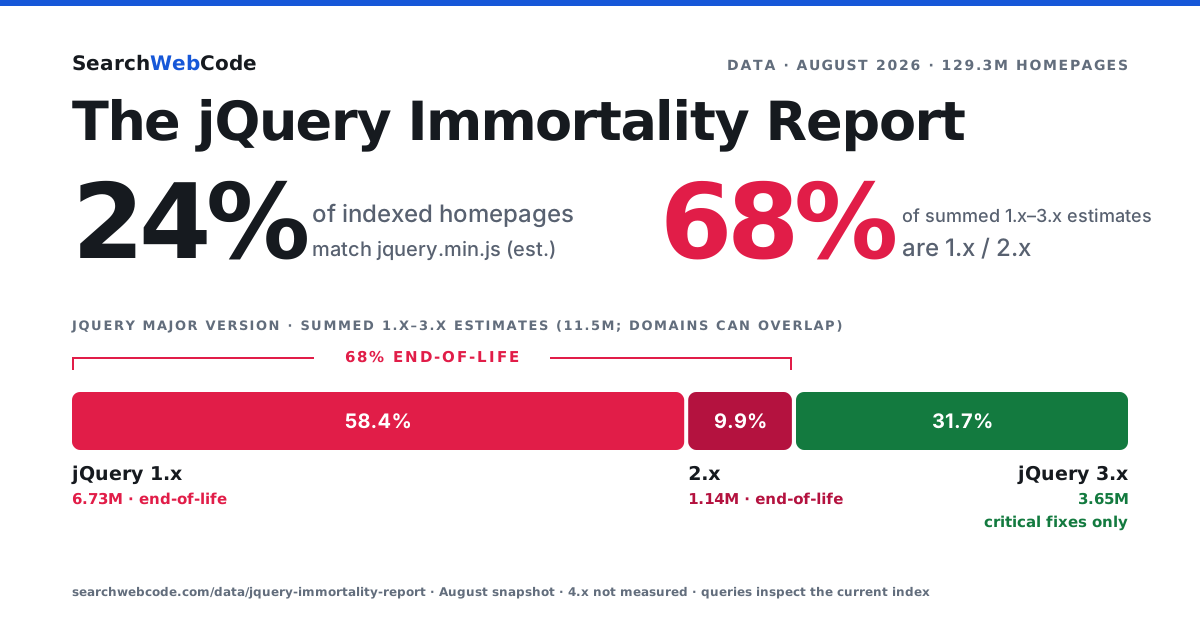
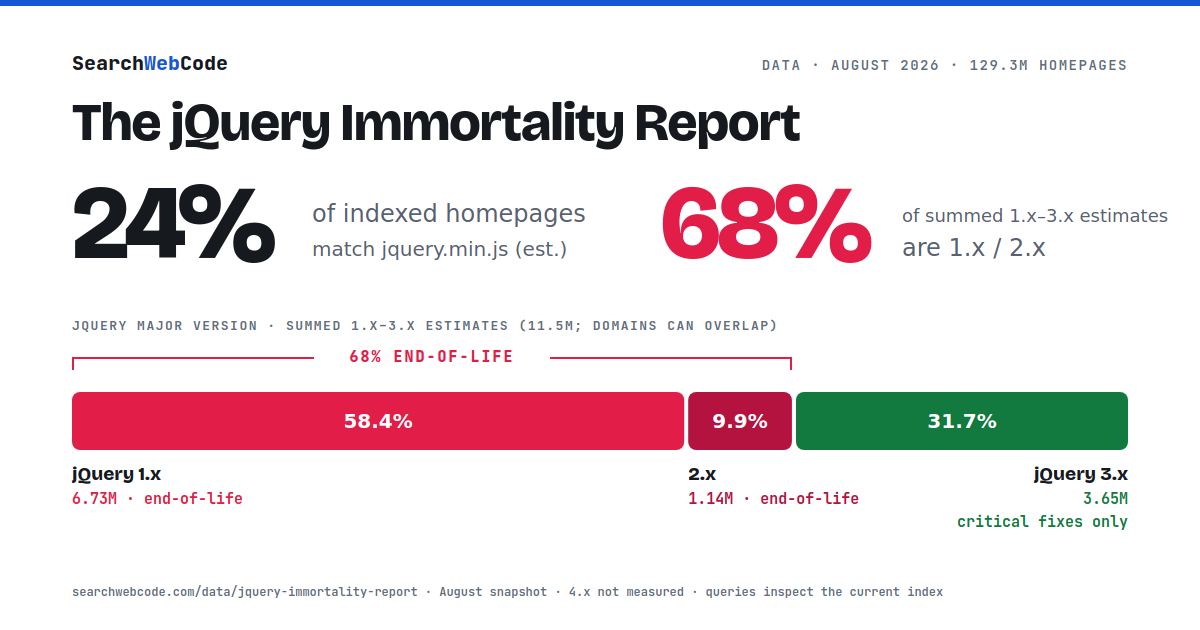
68% of the summed measured version estimates are 1.x/2.x
The historical version queries covered 1.x, 2.x and 3.x filenames only. They did not measure 4.x. According to jQuery's official support policy, checked October 14, 2026, 4.x is current; 3.x receives critical security patches and bug fixes, and 1.x/2.x are unsupported by the project.
end-of-life · last release May 2016
end-of-life · last release May 2016
critical fixes only; 4.x is current
jQuery 4.x: not measured in this report. This does not mean no sites used it. Run a current 4.x filename query to inspect the current index. Pages can load multiple versions; unversioned filenames and 4.x are excluded from the historical ratio.
Support status and security
A filename match identifies source code worth reviewing. It does not prove that the library executes, that an exact vulnerable version is present, or that a site is exploitable. Check the full source, the exact release and the relevant upstream advisory before making a security claim. jQuery's 4.0 upgrade guide describes migration to the current branch.
The jquery-migrate.min.js footprint has a reported estimate of 17,600,000 homepages. Migrate is a compatibility tool; its presence alone does not establish an outdated or vulnerable installation.
Why jQuery is immortal: WordPress
The specific wp-includes/js/jquery/jquery.min.js path has a reported estimate of 18,200,000 matching homepages. The wp-content query has a separate reported estimate of about 24.9M. These queries measure visible source footprints and can overlap.
The core-path filename does not carry a jQuery version, and this report did not measure WordPress release versions. It therefore cannot establish how current the unversioned WordPress population was. Inspect the current core-path results →
jQuery vs the frameworks that were supposed to replace it
The archived estimates below use the same 129.3M-homepage index, but each query has different coverage. They compare selected visible source footprints, rather than complete populations of framework installations.
Footprints: jquery.min.js · /_next/static · react-dom · /_nuxt/ · data-server-rendered · htmx.min.js · alpinejs · ___gatsby
The listed framework estimates sum to about 4.44M detections. The canonical jQuery estimate is about 7 times that sum. Overlapping framework populations and different fingerprint coverage prevent a comparison of unique installations or market share. Production bundlers can erase library filenames, so React and Vue references can be missed. A Next.js footprint measures that framework rather than all React deployments. These are comparisons between the stated query footprints.
Who still serves jQuery
Google Hosted Libraries and the official code.jquery.com CDN each have reported estimates exceeding three million homepage source references in the archived table.
Each label re-runs its query. CDN queries sum to about 9.42M detections; their populations can overlap and cover different filenames from the canonical query.
Public-CDN references total roughly 9.42M against 31.5M canonical-filename homepages, and most CDN loads use versioned filenames that the canonical count does not even include. These overlapping queries do not establish the share of all installations served by CDNs or self-hosted.
Methodology
The source snapshot is August 2026; the recorded sampling re-check date is September 4, 2026. SearchWebCode compiled the retained table from a trigram index over 129,313,463 homepages, one per unique domain. A query first yields the set of candidates, every page containing all of the footprint's trigrams, and that candidate total is an upper bound. Verification then fetches a sample of candidates, checks each against its stored source, and scales the observed match rate to the whole set. The figures on this page are the reported rounded sample estimates. For short, distinctive footprints the two numbers nearly coincide (react-dom verified at 100% of candidates); for footprints whose trigrams also occur in other strings they diverge, sometimes by a factor of three, and only the reported sample estimate is used in these charts. The CSV carries both columns.
Current live queries use the current index and can return sample-based estimates. Their totals may differ from the archive because of both corpus changes and sampling uncertainty. The originally published method describes re-running footprints per top-level domain across the 26 largest TLDs (80–88% of each candidate set), about 830 verified probes per footprint, and the summed rate was scaled to the full set. The retained table records the rounded estimates; raw per-TLD responses are not included in the download, so the original sampling cannot be independently reconstructed from this artifact alone. Version lines use the regex jquery-N\.[0-9.]+\.min\.js, which counts only filenames that carry a version; the verified samples returned correctly-versioned files. The original estimates are retained at their reported three-significant-figure precision. Rounding does not establish a statistical confidence interval.
Known limitations, stated plainly: this is a homepage census, not a whole-site crawl, so jQuery used only on inner pages is not counted. Filename fingerprints miss jQuery that is bundled under a custom name, inlined, or injected at runtime, so these queries do not cover every way jQuery can be shipped. Version detection needs a version string in the filename; a self-hosted jquery.min.js is counted in the headline but not attributed to a version line. Presence in source does not prove the code executes. The index is refreshed quarterly, so numbers drift slightly between builds; this page is pinned to the August 2026 build.
Share or embed the chart
The headline chart is a static image you can drop into a post or slide. The snippet links back here so readers can inspect the archived table and its measurement limits.
How to cite and reuse this report
Every figure retains its query footprint and source snapshot date. Cite it as: "The August 2026 SearchWebCode homepage index found about 31,500,000 domains (24.4% of 129.3M) matching the jquery.min.js filename, and a 68% share for 1.x/2.x within summed 1.x–3.x version estimates, excluding 4.x and unversioned filenames." The full dataset is a dated CSV, jquery-immortality-2026-08.csv, with candidate bounds, reported rounded estimates and measurement labels. Reuse is welcome with attribution: cite "SearchWebCode, August 2026 index" and link this page.
The current labelled query measurement appears on the jQuery technology page; this report is the dated, citable snapshot. See the live jQuery footprint →
Data quality & editorial policy
Published totals state their measurement type: candidate bound, checked-sample estimate, exact matches or an unclassified historical total. A linked current query can inspect a footprint, but does not reproduce an older index snapshot. Snapshot dates stay distinct from editorial correction dates. Read our methods and corrections policy.
Frequently asked questions
What does the headline jQuery estimate cover?
About 31,500,000 homepages in the August 2026 index of 129,313,463 domains contain jquery.min.js, a reported sample estimate from checked page source. It covers that filename in stored homepage source. Other filenames, bundled code and runtime execution are outside the query; sampling adds uncertainty.
What does the 68% figure measure?
The sum of the reported 1.x and 2.x estimates divided by the sum of 1.x, 2.x and 3.x estimates. The report did not measure 4.x, excludes unversioned files, and does not deduplicate pages that load multiple versions. It is not the share of all jQuery installations.
Is jQuery 3.x the current branch?
No. Official jQuery support identifies 4.x as current. The 3.x branch receives critical security patches and bug fixes; 1.x and 2.x are unsupported by the project.
Does a legacy filename prove a vulnerability?
No. A footprint is a source reference to investigate. Establish the exact release, execution context and applicable upstream advisory before assessing exposure.
How do candidate bounds and match estimates differ?
A candidate bound counts pages passing the index prefilter. A sample estimate scales the match rate of checked source pages. Technology pages label their current measurement type; this archive records historical rounded estimates and candidate bounds. The CSV includes both.
Can I reproduce these numbers?
Each footprint links to a current query and the dated table is downloadable. Current queries use the current index and can vary with sampling. The original August source index and per-TLD sample responses are needed to reproduce the historical estimates exactly.